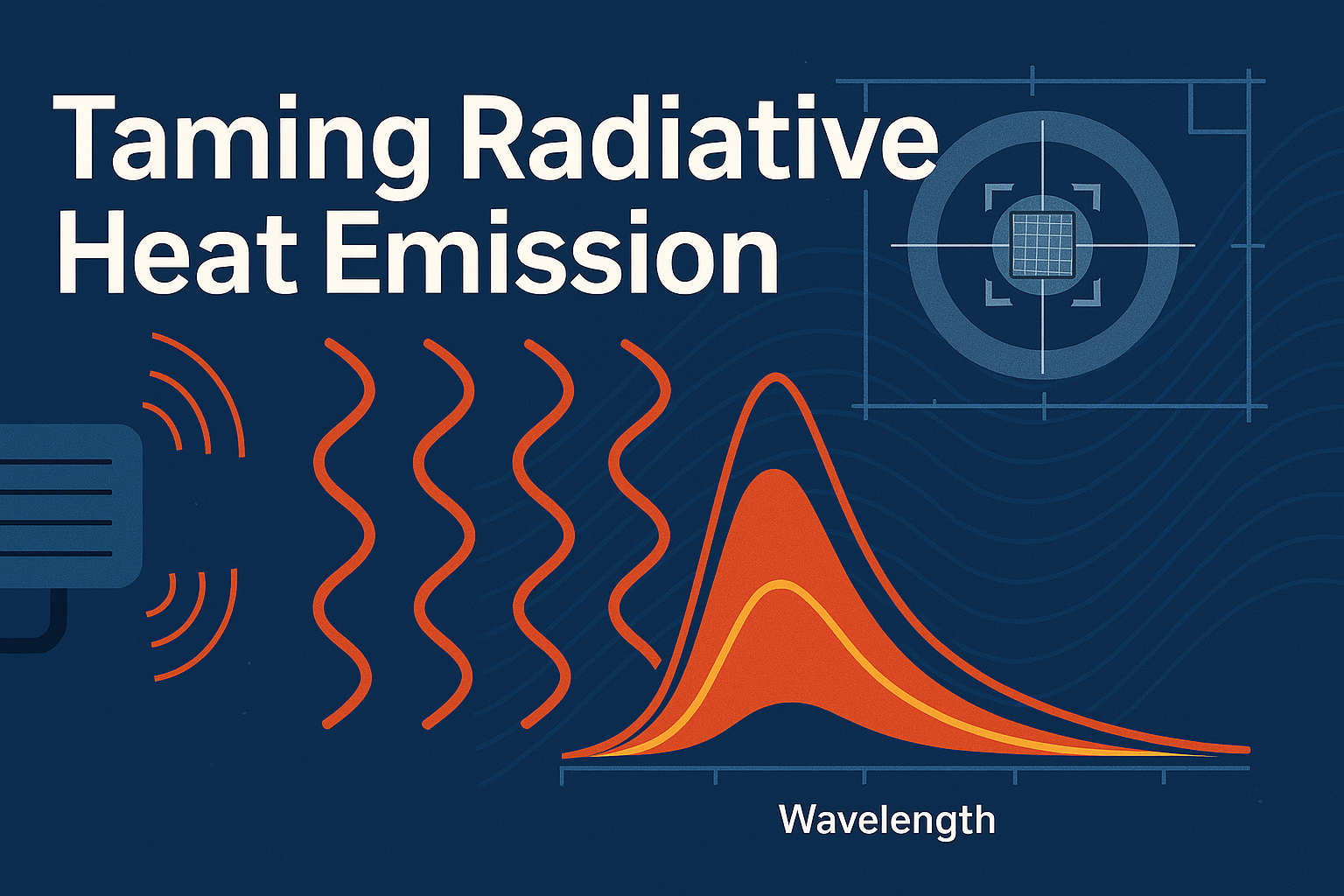
Taming Radiative heat Emission with Anisotropic and Time-varying media
Thermal emission is a key process in energy transport and temperature management, but it is hard to control. Its random nature leads to a broadband spectrum that lacks directionality and polarisation. As a result, many applications in science and engineering face challenges and limitations. In this context, the ERC-funded TREAT project aims to develop a new approach to manipulate thermal radiation properties. By combining time-varying and hyperbolic materials, TREAT’s approach seeks to overcome the constraints of existing laws governing thermal emission. TREAT addresses fundamental aspects of thermal emission physics to enable active control over the spectrum and directionality, paving the way for advancements in radiative cooling, energy harvesting and optoelectronics.
What the TREAT project aims to do
Thermal emission is a fundamental and ubiquitous process of energy and entropy transport, impacting science and engineering in various way. Yet, its stochastic nature, expressed in a broadband spectrum, lack of polarization and directionality, severely limits its control and manipulation. TREAT aims at introducing a novel method for engineering the radiative heat transport and achieving unprecedented dynamical control over the spectrum and the momentum of thermal radiation. To achieve this goal, I propose to combine two classes of emergent materials: time-varying epsilon-near zero (ENZ) media and hyperbolic materials (HMs). The time modulation of ENZ media will allow to overcome the fundamental limits to thermal emission set by the Planck’s and Stefan-Boltzmann’s laws and achieve active control over its properties. While the HMs, will enable to extract and guide the intense thermal radiation confined at the emitter surface, i.e. in its near-field. TREAT objectives address three intriguing questions:
- Can we create a time-varying media with ad hoc time modulation?
- Can we manipulate thermal emission beyond the Planck’s law using the time-modulation?
- Can we improve our control of the radiative heat flow in the near-field?
Answering these questions requires the combination of expertise in nanophotonics and ultrafast science and perfectly suits my scientific profile. TREAT specifically targets the thermal emission engineering in the transparency window of Earth atmosphere, relevant for radiative cooling, and the development of novel coherent thermal sources in the THz range. TREAT will provide a fundamental advance to our understanding of thermal fields, beyond fluctuational electrodynamics, and a novel method for engineering the radiative heat flux, anticipating significant impacts in several applications of thermal light that would benefit from the active control of its properties, such as radiative cooling, energy harvesting, and optoelectronics.